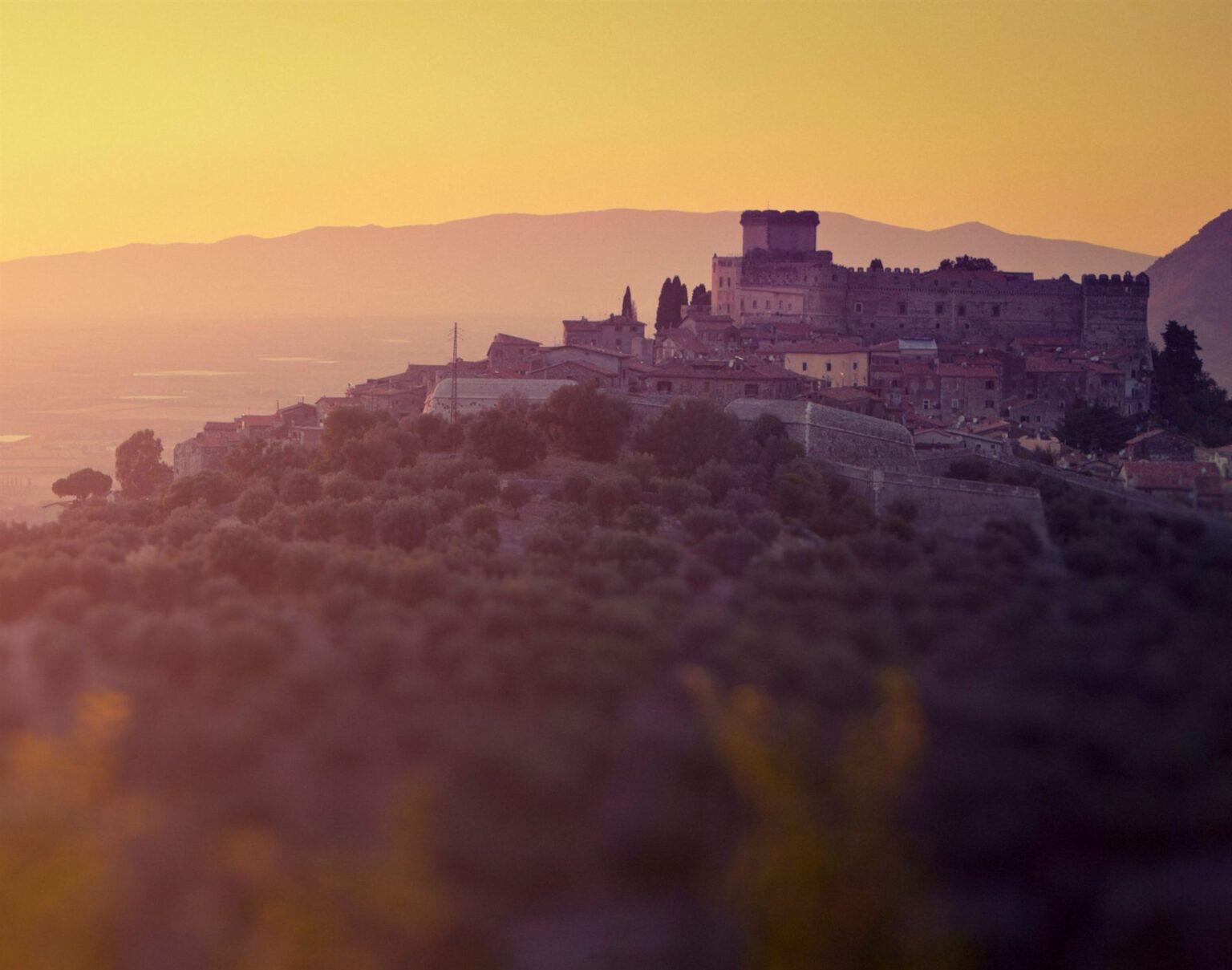
If you drive down towards Circeo via Latina you see Sermoneta for only a few seconds: a block of pale stone resting on the Lepini Mountains, above the plain. Almost everyone drives straight on to the sea. That's a shame, because if you're wondering what to see in Sermoneta, the answer is half a day on foot, among a medieval castle that's still intact, a fifteenth-century panel that hides a surprising detail and lanes you can only explore by walking.
It's not just a pretty postcard. Sermoneta is one of the most beautiful villages in Lazio for a concrete reason: the historic centre has stayed compact within its walls, with the castle on top and the village huddled around it. The Touring Club Italiano has awarded it the Bandiera Arancione (Orange Flag), the quality mark for small inland towns.
Where Sermoneta is and why it's an easy stop
The village stands at 257 metres above sea level, on the first step of the Lepini Mountains, in the province of Latina. It's about 70 km from Rome, an hour by car: an easy day trip from Rome that doesn't need an early start. From Sermoneta to San Felice Circeo it's about 47 km, just under an hour. In practice, if you're arriving from the north you're already on the right road: the detour inland costs little and shows you another Lazio before the sea.
You can do it without a car, with a little patience: regional trains from Roma Termini reach Latina in about 40 minutes (from 4 euros), then you need a bus or a taxi up to the village.
What to see in Sermoneta: the four stops that matter
The Castello Caetani, but only with a guided tour
It's the reason many people come up here, and it's also the part that needs the most planning. The castle dates from the thirteenth century, passed to the Caetani in 1297 and at the end of the fifteenth century spent a few years in the hands of the Borgia: Lucrezia was its lady. Inside you can visit the Camere Pinte, with fifteenth-century frescoes of mythological subjects, the Sala del Cardinale, the walkways and the prisons.
You can't just walk in. The visit is guided, in time slots and with limited places, run by the Fondazione Roffredo Caetani (the same one that looks after the Giardino di Ninfa). The entrance contribution is 8.25 euros and it's booked online on the Foundation website. The internal stairs are stone and steep: the castle isn't accessible for people with reduced mobility.
The Madonna holding the town in her arms
In the Cathedral of Santa Maria Assunta there is the Madonna degli Angeli, a mid-fifteenth-century panel attributed to Benozzo Gozzoli. Look at it closely: the Virgin holds a small model of Sermoneta in her lap, with walls and towers. It's the oldest known view of the village, and it offers a simple game: compare it with what you see as soon as you leave the church, almost six centuries later.
The Loggia dei Mercanti and Troisi's scene
A Gothic portico from the mid-fifteenth century, built by Onorato Caetani as the seat of the town council, a place of business and public assemblies; the stables were beneath the arches. If it looks familiar, it's because this is where Massimo Troisi hears «Remember that you must die» in Non ci resta che piangere (1984). You know his answer.
The alleys, the Synagogue and San Michele Arcangelo
The rest you discover by wandering without a fixed destination. The Synagogue recalls the Jewish community that lived in the village; San Michele Arcangelo stands at the oldest point of the town, wedged between medieval houses. Allow a good hour just to walk, stop at the viewpoints and look down over the Pontine plain, which on clear days stretches all the way to the sea.
Things you may not know about Sermoneta
- A set for over 90 films. The village has been used as a film set more than 90 times: among the titles, The Taming of the Shrew by Zeffirelli (1967) and Tale of Tales by Matteo Garrone (2015).
- The Sator square in a circle. At Valvisciolo Abbey, a few minutes by car, you'll find the SATOR AREPO TENET OPERA ROTAS palindrome laid out in a circle instead of a square: it's the only known example in this form.
- The cathedral without a bishop. Everyone calls it that, but Santa Maria Assunta has never been an episcopal seat: technically it is a collegiate church.
- Castle and Ninfa, same story. Both are looked after by the Fondazione Roffredo Caetani, set up in 1972 by Lelia Caetani, the last of the family, so that the two places would continue to be cared for after her.
Practical tips for visiting Sermoneta, even in winter
- Leave the car outside the walls. The car parks are outside the historic centre and you walk up from there: allow for a bit of a climb even before you reach the castle.
- Check the castle calendar before you go. At this time of year visits are concentrated at weekends and on public holidays: Saturday 21 and Sunday 22 November, 28 and 29 November, 5, 6 and 8 December, 1 January. Places are limited, so book a few days ahead rather than on the same morning.
- In winter Ninfa is closed, but Sermoneta isn't. The Giardino di Ninfa opens by reservation at weekends between late March and early November (in 2026 the last opening was on 8 November). From December to March the village is the right choice for anyone passing through; in spring, though, you can combine Sermoneta and Ninfa in the same day.
- Add Valvisciolo if you have an extra hour. The Cistercian abbey, built between 1150 and 1170, sits at the foot of Monte Corvino between Sermoneta and Norma. It's the easiest way to extend your stop without straying far from the road.
- Shoes with a proper sole, not sandals. The paving, steps and stairs of the castle are stone and can be slippery in winter.
- Keep an eye on December and January. During the festive season the village fills with lights and nativity scenes, and in January the polenta festival returns, one of the town's most heartfelt traditions. You'll find the dates for the current edition on the Comune's website.
Why stop at Sermoneta before Circeo
Among the villages near Circeo, Sermoneta is the best counterpoint to the sea. You almost always arrive at Circeo with your mind on the beach; here you find stone, silence and the plain seen from above. Arriving after crossing it changes the way you look at the promontory: you understand where the landscape comes from, not just where it ends.
As a stop it works like this: you arrive in late morning, take the guided visit, have lunch in the village and are in San Felice Circeo in the afternoon, in time for your first sunset. If you're planning the drive from the north, you'll find the other stops worth the detour in From Milan to Circeo by car. If you've already decided to stay a few days, our 48-hour itinerary at Circeo starts exactly where this day ends.
What to see in Sermoneta, in the end, comes down to three things: a castle to book, a painting to look at up close and a village to wander without hurry. The position does the rest. And if, after the village, you're curious about the less obvious Circeo, we've collected a few addresses in Circeo beyond the beaches.